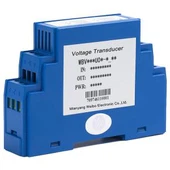
Hall current sensor is a sensor commonly used to measure current. It uses the Hall effect to measure current. The Hall effect means that when a conductor passes through a certain magnetic field, the current produces a voltage difference in the direction perpendicular to the direction of the magnetic field and the current.
In order to explain the measurement principle of the Hall current sensor in detail, we can explain it from the following aspects: Hall effect, the structure and working principle of the Hall current sensor, and the characteristics and applications of the sensor.
1. Hall effect
When a conductor or semiconductor material passes through a magnetic field, the components perpendicular to the direction of the magnetic field and the direction of the current will cause charge separation, resulting in a potential difference on both sides. This phenomenon is called the Hall effect.
The Hall effect occurs because carriers are affected by the Lorentz force. The Lorentz force refers to the force experienced by a current passing through a magnetic field. When the magnetic field and current are perpendicular to each other, the Lorentz force deflects electrons or holes inside the conductor and creates a potential difference on both sides of the conductor.
2. Structure of Hall current sensor
Hall current sensors usually consist of three parts: Hall element, magnetic circuit structure and output circuit.
2.1 Hall element: The Hall element is the core part of the sensor. It usually consists of a Hall chip. The Hall element has a special semiconductor structure, which includes a current transfer area, a Hall action area and a voltage measurement area. When a current passes through the sensor, the Hall active area will be affected by the Lorentz force, causing the Hall potential.
2.2 Magnetic circuit structure: The magnetic circuit structure is mainly used to control the distribution of the magnetic field and transmit it to the Hall element. The magnetic circuit structure usually consists of an iron core, magnetic field adjustment components and magnetic field shielding components. The iron core is used to guide magnetic field lines, the magnetic field adjustment element is used to adjust the strength and direction of the magnetic field, and the magnetic field shielding element is used to reduce the interference of external magnetic fields.
2.3 Output circuit: The output circuit is used to measure and amplify the Hall potential and convert it into a current or voltage signal. The output circuit usually consists of an operational amplifier, a filter circuit and an amplifier circuit. Through the processing of the output circuit, a voltage signal proportional to the input current can be obtained, thereby realizing the measurement of the current.