

As a supplier of high stability AC current sensors, I often encounter questions from customers about various technical parameters of our products. One of the most frequently asked questions is: "What is the fall time of a high stability AC current sensor?" In this blog post, I will delve into this topic to provide you with a comprehensive understanding.
Understanding the Concept of Fall Time
The fall time of an AC current sensor refers to the time it takes for the sensor's output signal to transition from a high - level state to a low - level state. It is a crucial parameter that reflects the sensor's response speed and dynamic performance. In practical applications, a shorter fall time means that the sensor can more quickly adapt to changes in the input current, providing more accurate and timely measurement results.
Let's take a closer look at how fall time affects the performance of a high - stability AC current sensor. In many industrial control systems, such as motor control, power distribution monitoring, and renewable energy systems, the current is constantly changing. A sensor with a short fall time can rapidly detect these changes and transmit the corresponding signals to the control system. This enables the control system to make timely adjustments, ensuring the stable operation of the equipment.
Factors Affecting the Fall Time
Several factors can influence the fall time of a high - stability AC current sensor.
Sensor Design
The internal design of the sensor plays a significant role. For example, the type of magnetic core used in the sensor can affect its response speed. A high - quality magnetic core with low hysteresis and high permeability can reduce the time required for the magnetic field to change, thereby shortening the fall time. Additionally, the circuit design of the sensor, including the choice of electronic components and the layout of the printed circuit board, can also impact the fall time.
Load Characteristics
The load connected to the sensor output can have an effect on the fall time. If the load has a high impedance, it may slow down the discharge process of the sensor's output signal, resulting in a longer fall time. On the other hand, a low - impedance load can facilitate a faster discharge, reducing the fall time.
Input Current Characteristics
The magnitude and rate of change of the input current also influence the fall time. A large - amplitude and rapidly changing input current may require the sensor to respond more quickly, which can put higher demands on the sensor's fall time performance.
Measuring the Fall Time
To accurately measure the fall time of a high - stability AC current sensor, specialized test equipment is usually required. The most common method is to use an oscilloscope. The input current is applied to the sensor, and the output signal of the sensor is connected to the oscilloscope. By observing the waveform of the output signal on the oscilloscope, the fall time can be measured.
The measurement process typically involves the following steps:
- Set up the test circuit: Connect the AC current source to the input of the sensor and the output of the sensor to the oscilloscope.
- Apply a step - change input current: Generate a step - change in the input current to simulate a sudden change in the current.
- Observe and measure: Use the oscilloscope to observe the output signal of the sensor. Measure the time it takes for the output signal to fall from 90% of its high - level value to 10% of its high - level value. This measured time is the fall time of the sensor.
Importance of Fall Time in Different Applications
Industrial Automation
In industrial automation systems, high - speed and accurate current measurement is essential. For example, in a robotic arm control system, the current sensor needs to quickly detect changes in the motor current to ensure the precise movement of the robotic arm. A sensor with a short fall time can provide real - time feedback, enabling the control system to make rapid adjustments and improve the overall efficiency and accuracy of the automation process.

Power Quality Monitoring
In power quality monitoring applications, the fall time of the current sensor affects the ability to detect transient events in the power grid. Transient events, such as short - circuits and voltage sags, can cause sudden changes in the current. A sensor with a short fall time can quickly capture these changes, allowing power grid operators to take timely measures to protect the power system.
Our High - Stability AC Current Sensors
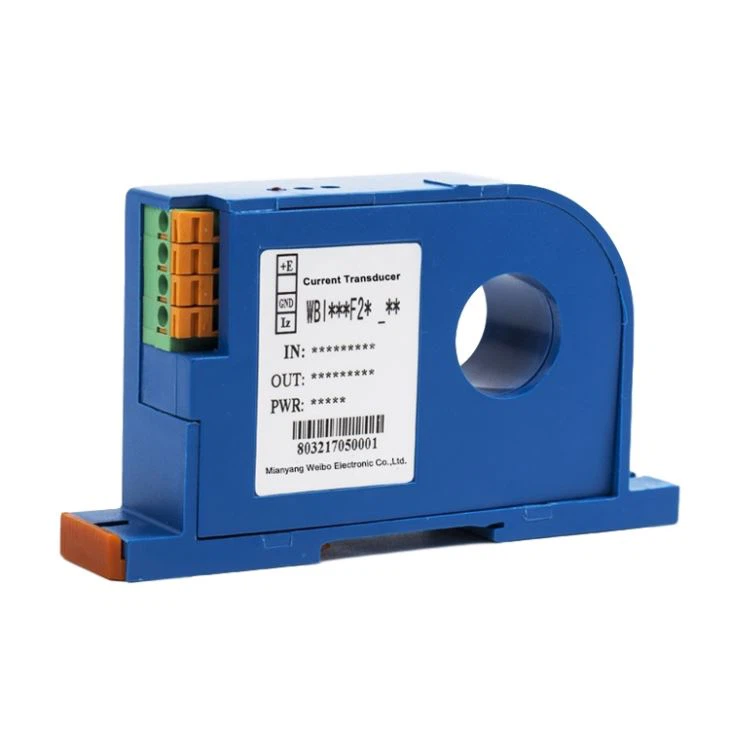
At our company, we offer a range of high - stability AC current sensors with excellent fall - time performance. Our 4 to 20mA Output Current Transducer is designed to provide accurate and reliable current measurement. It has a short fall time, which enables it to quickly respond to changes in the input current.
Another product, the 30A to 400A Input AC Current Converter, is suitable for high - current applications. It is engineered with advanced technology to ensure a short fall time and high stability, making it an ideal choice for industrial power systems.
Our 4 to 20mA Output Current Sensor Low Power is also a popular option. It not only has a short fall time but also consumes low power, which is beneficial for energy - efficient applications.
Contact Us for Purchase and Consultation
If you are interested in our high - stability AC current sensors or have any questions about the fall time or other technical parameters, please feel free to contact us. We have a professional team of engineers who can provide you with detailed technical support and help you select the most suitable sensor for your application.
References
- "Principles of Electrical Measurement", John Wiley & Sons
- "Industrial Sensor Technology", Springer Publishing